| | Home >
Kitchen >
Range Hoods >
Choosing a Range Hood | | | |  | | | | | | | An Expert's View | | |  |
My name is Michael Gleeson and I have been involved with kitchen ventilation for over
59 years, initially as an owner of kitchen cabinet design and
installation firms (31 years) and for the past 28 years as founder of KitchenSource.com and RangeHoods.com.
I know just how confusing it is for you to select the right range hood for your kitchen project and I am happy to share my expertise in the hope that your final selection will be perfect for your
home. | | | |
| | | | | | | | It may seem obvious, but the "why bother with a range hood?", needs reviewing as a beginning to your quest. The primary purpose of kitchen ventilation is to reduce cooking smells, heat and condensation by extracting them outside. Another important purpose
of a range hood is to trap grease to prevent it from being deposited all over your kitchen.
|  | | | | | | | | | Under Cabinet Mount | | |
 | Just as the title says, this type
of range hood is fixed to the bottom of a cabinet. It may duct directly out
the back, may go up through the cabinet or, may go up a little and then out the back. You may lose some storage in the cabinet, but so what?
- it's always messy above the hood and never easy to get access
to anyway! Very few of this type of range hood have an remote blower.

|
| | | Wall Mount | | |
| This type of vent hood is directly
affixed to the wall and may have a decorative chimney, or soffit, to line up with the top of your cabinets or to "disappear" into your ceiling. It may have an internal or remote blower,
and it may duct straight out the back, be ducted straight up, or up and then horizontally.
|  |  |
| | | | | Ceiling (Island) Mount | | |
 | This type of range hood hangs from the ceiling over an island or peninsula. It may also hang from peninsula wall cabinets. You may choose to hang it higher to avoid blocking a view and, if so, it will need more coverage than
it would in a wall mount situation. I would recommend at least an additional 3" all round (30" stove would require a 36" hood. It will also need more CFM to compensate for the extra height and for breezes passing through your kitchen.
|
| | | | | Downdraft Ventilation | |
Venting downwards has come a long way in the last 20 years and is mostly used in kitchen island or peninsula situations. This type of unit can also be used for a cooktop near a wall.
But why? The fumes are drawn downwards under the floor and out (like for a clothes dryer) or into a basement and out. A lower powered model, suitable for an electric or small gas range top, often has the power pack placed in the cabinet beneath. A higher powered unit is usually placed in the basement and thus avoids the loss of storage
an in-cabinet model may cause in a kitchen cabinet. Of course, you may choose to put lower powered units in the basement too to avoid
this loss of storage.
|  | Downdraft units are relatively inefficient because they have to fight the natural upwards flow of air and are most often used in an island situation if you don't want to block a view - or if your range top needs to be placed in front of a window.
Some downdraft models run from the front to the back of the countertop and are mostly used between modular stove tops; others have their vents at the back edge of the stove top but will not fit whenever a full size range top is in use (unless the countertop is increased in depth).
|
| | | Ventilator Power Packs [also known as Hood Inserts, Custom Power Packs, Kitchen Power Packs,
or Range Hood Liners] | | |
 | These power packs contain the "guts" of a custom or made-to-order range hood and contain the blower(s), grease trap(s), lights and (usually) controls.
They are intended mainly for use in custom or wood hoods or "your own" style hood. They fit into your own creation or into a shell of wood, plaster or metal manufactured by others.
Power Packs often come with an easy-to-clean, powder coat metal or stainless steel
liner to ensure a snug and easy-to-clean bottom for your hood.
|
| | | Wall Ventilation Fan | | |
Even though it may not be easy to duct your range hood to the outside, don't be tempted to install a wall
ventilation fan instead. Such a fan may be good for overall ventilation but useless for clearing the fumes from a range top.
Plus you will have grease on all your walls and surfaces. If you do have a wall fan installed
as well as a range hood, make sure to turn the wall fan off while using your range hood, otherwise your hood will be ineffective.
|  |
Top
| | | | | | |
100-300 CFM
|
300-600 CFM | 600-900 CFM
| 900-1200 CFM
| 1200 CFM and up
|
| | Cubic Feet per Minute (cfm) is a measure of the volume of air being exhausted
through your range hood. This measurement is always based on when the hood is
running at full speed and at zero pressure, i.e. without the resistance of any ducting. Depending on
its distance to the outside, the type and number of bends, and the resistance of the blow-back damper and wall plate, this output may be considerably reduced.
The cfm requirement for your kitchen will depend on the type and output of your range top, the size of the hood, the positioning of the hood, plus the length and configuration of your ductwork. Every situation is different so I can only make average suggestions for the cfm required; but I can say
with confidence that it is better to have too much than not enough. | | | | | | Suggested CFM requirements for Cooktops: | | | Electric: | | | Generally speaking an electric cook top is low powered and should only need a range hood output between 150cfm - 300cfm.
If you have an electric deep fat fryer you will need to treat it as
if it was a gas stove top.
| | | | | | Gas: | | |
"Regular" gas cook tops have outputs of up to around 40,000btu [British Thermal Units] and, since they are almost always used in an "against the wall" situation, you can use
this simple formula to help make your choice. Calculate your cook top's btu rating by adding the power of each burner and then divide the total by 100, e.g. a 30,000btu top will require a 300cfm fan.
| | | | | | High Output ["Professional"]: | | Professional style range tops can reach outputs akin to a small stove in a restaurant and they can generate enormous amounts of heat. The simple calculation of Total BTUs/100 = CFM (e.g. a 60,000 BTU top will need 600cfm blower) is fine in
many situations, but you may need to consider more CFM:
| | | if you have an extra long run of ducting (especially with 90degree bends). if the range hood is positioned extra high over the range top; if you cannot provide a bigger catchment area by choosing a width and depth greater that the range top - especially in an island or peninsula situation; if you want to keep the noise level down by choosing an extra powerful hood but running it at a lower setting. | Top
| | | | | | | | Centrifugal blowers [also known as squirrel cage blowers] | | | | | Your hood will likely have either a centrifugal squirrel cage blower or an air-ring fan. The centrifugal
blower is more efficient, delivers more CFM and is less noisy but usually more costly. It operates like a paddle on a riverboat steamer and drives air upwards.
An Air-Ring fan [aka fan blade; rotary] discharges horizontally and is noisier,
more economically priced, but less efficient. | | | Top
| | | | |
This is a tricky one. You may feel a conflict between how effective you want the range hood to be and
how you would like your hood to look. Smoke, steam and grease from your cook top will not naturally flow up in a straight stream but tends to wander. So your range hood needs to have sufficient CFM and adequate coverage over your range top to trap these fumes. Note that range hoods are actually made a tad smaller in width than stated so they will fit a standard space e.g. a 30" hood is made to fit in a 30" space.
When choosing a Wall Mount or an Under Cabinet range hood, keep in mind these factors:
Height from range top:
The lower the better, especially for low cfm hoods. If you have an electric cook top then 18" and up is fine but if you place the range hood as low as 18" you may not be able to see into your pots. For a gas top under 40,000 btu, 20" if often recommended but I prefer 24" because a gas flame has been known to jump a gap of up to 20". This is especially possible if a gas ring is turned on without any pot on it or if the range hood grease trap has not recently been cleaned.
The higher your range hood is from the range top, the less effective it will be, so it is important to compensate for extra height by increasing CFM and/or coverage (width and depth). Hoods 600 CFM or higher should be raised to 30" at least but anything over 30" may make all the dirt and grease on the grease trap visible.
As I have already said "The higher your range hood is from the range top, the less effective it will be" but a major consideration is keeping your head intact. I have suffered some nasty cracks to the noggin in my time so I suggest 30" high when the hood is 24" - 27" deep and the CFM is 600 or more; 24" for a hood 22" - 24" deep and up to 500cfm;
and 18"- 20" for an electric or low-powered gas top up to about 40,000BTU.
| |  |
Careful planning of your wall cabinet
layout in relation to your base cabinets may allow you to leave a
space for your vent hood at least 3" wider on each side than the
range top. This extra width will carry off much more of the fumes
and make your kitchen ventilation that much better. If you decide to
match the hood and cook top width, just watch out for possible
scorching of the bottom inside corners of the cabinets, especially
if they are only 12" - 15" off the countertop surface - more especially if you are using gas.
Depth (front to back):
Most countertops are 25" deep. Under-cabinet and wall mount kitchen exhaust hoods come
in depths of approximately 20", 22", 24" and 27". 20"
deep is fine for electric and low output gas tops, especially if they are only 18" - 20" above the range top. I suggest 22" or 24"
deep when the hood is over 500cfm, and 27" deep if over 850cfm.
| Top
| | | |
| | | | | It is really important that the size of the ducting to the outside of your range hood is correct. Under-sizing will cause blow-back resistance and buffeting,
resulting in increased noise levels. Under no circumstances use ducting
made from material other then metal! | | | | |
Size of Ducting:
As a rule most Under Cabinet and many Wall Mount range hoods up to
600cfm specify a standard 6" round ducting or equivalent rectangular ducting. However, in some
states, 6" may not be available because the standard available is 7" round. Using 7" when 6" is specified is fine and will slightly increase your hood air flow, while using 6" in place of 7" will reduce the flow a little. Although many range hood manufacturers suggest that 6" ducting is ok for 600cfm, I strongly recommend 8" (7" is fine too if
that's all that is available to you).
Long runs:
If your duct run is longer than 20 feet I would suggest you add an additional 100cfm, plus an additional 100cfm for each 90 degree bend.
Shape:
Mostly, ducting comes round. But it is fine to use square or rectangular
ducting provided it will carry the equivalent volume of air, e.g. 6" round may be replaced with 3-1/4" x 10" rectangular. Some range hoods come with a transition piece included. Use of rectangular ducting can be a life saver
if laid on top of your cabinets where crown molding can hide it or
when used with a less bulky soffit.
Try to avoid flexible ducting (unless you can pull it taut) as the corrugated inside surface will cause resistance and buffeting noise.
Damper:
Check to see if the hood you
choose has a built-in Backdraft Damper. If not, include it in your
duct run, usually as part of the outside wall or roof cap.
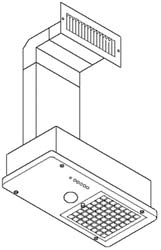
Ducting Scenarios:
 | - Directly outside - requires less CFM
- Up around 9" and then outside with a 90 degree bend -
requires less CFM and will be quieter
- Up and through the roof - needs more CFM
- Down and out - needs a lot more CFM
- Up and sideways on top of your cabinets - needs some more CFM
- Through back wall into another room and outside from there -needs some more CFM
| | Internal Blower Typical Ductwork | |
Top
Ductless Range Hoods [also known as Recirculating hoods, Vent Free hoods or Non-Ducted hoods] | I consider a ductless hood to be a last resort if you cannot find a way to get the waste to the outside. While such a hood will trap grease and will kill odors (while the charcoal in the filter is still active) it will not reduce
the condensation and smoke caused by cooking. This is especially a problem if you cook with gas that generates a lot of condensation. Depending on how much you cook you
may need to replace the carbon filters every 2 - 6 months to deal with the cooking smells.
My experience of over 48 years showed me that some builders/remodelers may
tell you that your situation will not allow for you to duct a range hood, when in fact with a little more work, it will be possible.
While it may cost a little extra, over the years you will benefit enormously from a properly vented range hood.
Many regular hoods can be used in either of two modes - a) as an exhaust hood or b) as a recirculating hood by fitting a ductless conversion kit (often included free) plus charcoal filters.
|  |
Top
| | | | | |
| | | Most range hoods have their fans or blowers mounted inside the hood. An Exterior blower installed remotely from your hood, on an outside wall or on your roof, may be an option to consider if you are concerned about noise - but only if it is installed more than 15 feet away. If your external blower is installed on an outside wall directly behind your range hood it will not be less noisy.
In fact, if the blower is installed within 15 feet, the sound level may actually be increased because almost all exterior blower units are noisier in and of themselves.
|  |
 | Exterior and Inline fans are a little more efficient because they pull rather than push the air through your range hood and are a "must consider" if your required cfm level is very high - say 1,000 - 1,500 cfm and above. (Note that Imperial offer very high outputs using twin internal fans that deliver 1,200cfm or 1,330cfm at the sound level of
only one 600cfm fan. Two or more blowers operating at the same speed and frequency will not increase the noise level beyond that of one only).
|
An Inline blower, placed in the duct run somewhere between your hood and the outside wall or roof plate is another option.
However, while the noise level of the fan motor may be reduced or eliminated, you may experience vibration noise from the ducting.
An exterior blower cannot be used in conjunction with an interior blower hood. This would blow one of the two blower motors.
Every situation is different but I usually advise my customers to avoid the additional expense if there is no clear advantage to be had by using remote blowers.
| Top
|
| | | | Noise Level [Sones, Decibels (dbA)] | | | |
2.1-3.0 Sones |
3.1-4.0 Sones |
4.1-5.0 Sones |
5.1 Sones and up
| While my customers obviously want an efficient smoke free kitchen, one major concern
often expressed to me is the noise level - and I am fairly sure it is a big concern for you too.
Most of the noise from a range hood comes from the blower motor but a considerable level also comes from the rush of air through the ducting. This can be a lot more if the ducting is incorrectly sized (example,
when using a 6" diameter duct for a hood that requires 8").
Or when there are too many 90 degree bends or the external grille is of the wrong type, (i.e. more resistance = more noise). |  |
  | The noise level of a range hood is always measured at its highest output but will be much quieter at a lower output setting, eg a 600cfm hood at 4 Sones may have a variable or multispeed control that reduces the noise level to as little as 2 sones at
its lowest setting. | |
Reference Table: The lower the number, the quieter the hood.
See Table for rough guide of Sone and Decible comparisons.
Please keep in mind that the experience of sound is subjective and only becomes noise when the level is objectionable to the listener. The measurement for noise here in the USA is expressed in Sones, but since
many range hoods available here are actually made abroad, you
should be aware of the Decibel scale used in most of the rest of
the world. Each measurement scale is widely different in its approach
- Sones are linear, e.g. 2 sones is twice the noise level of 1 sone, 3 sones is three times. Decibels are progressive, e.g. a measurement of 50.1 decibels is only a little noisier than that of 50 decibels. Pressure, frequency and distance from the source affects the perception too, but because the same situation will be present in your kitchen regardless of which vent hood we choose,
we can ignore these factors in our basic comparative
calculations. To my ear, a measurement of 2 sones is about the same as a humming refrigerator while 8 sones is akin to a
running tractor!
| Approx. Conversion Table | |
| |
|
Obviously quieter is better, but make sure your hood has sufficient power for the job.
It may make sense to buy a higher output hood than you need and run it at lower speed. This will reduce the noise a lot. Also make sure it has a variable speed control or multispeed even if more costly.
Consider the extra cost against the number of years of aggravation saved!
|
| |
Top
| | | | |
| | |
Grease traps are designed to catch the grease that is suspended in the fumes rising from your cooktop. These are three types
of traps are in widespread use: Mesh, Baffle and Cup.
Aluminum or stainless steel MESH traps are the most common and
can be very effective. However, they need frequent cleaning to prevent clogging, thus reducing airflow, so make sure they are dishwasher safe. Careful handling is called for to prevent pushing them out of shape (replacements can be got from most manufacturers).
BAFFLE filter traps are often chosen because of their "professional" appearance but they are actually better because they trap more grease while they do not block or reduce airflow. They are also rigid and will hold their appearance indefinitely - just make sure they
too are dishwasher safe.
A CUP trap is a clever but unusual way to trap the grease, a bit like a tray under a barbeque, and is available on only a few models.
With all grease traps, the risk of fire is real if you do not keep them clean. A glob of grease can drip onto an open flame and poof!
FILTERS are usually made of charcoal and their purpose is to absorb cooking smells. They do need changing, frequently or less so, depending on the amount of cooking you do. They are
commonly used only for hoods that are not vented outside.
Top
| | | | Outdoor Hoods [Lanai Ventilation] | | | | |
| | Coverage and power are need to deal with the huge surge of fumes
from a barbeque when food is first placed it. Some quality stainless
steel hoods such as those made by
Imperial are available in 27" or 28" depth to provide better
coverage. Depending on the btu rating of your barbeque, any quality
stainless steel hood with air flow rates of 600 - 1,500 cfm will be
fine. But do not expect a lifetime from an outdoor hood. Even high
quality stain less steel will corrode eventually. Consider adding a
clear coat lacquer, especially in hot, humid, salty areas.
Top
|
| | | | | | |
Effectiveness:
A Range Hood can only be effective if it is "on" and running when
the range top is first turned on. If is not capable of clearing an
already smoke-filled kitchen!
Gauge and quality of Steel:
I am sometimes asked about the gauge of steel in range hoods but
it is really not relevant. Unlike a sink that gets a lot of banging
about, a range hood is quite ok with relatively light weight gauges
of 18 - 24 (lower is thicker) because its manufactured shape give it
sufficient rigidity until it is permanently installed. Most
stainless steel hoods are brushed to match your other appliances. Grade 304 is most often used because it has a higher
chromium and lower carbon content that provides fro excellent
resistance to corrosion. If you intend to use your hood outdoors, I
suggest you lacquer it for further protection.
Safety:
Possible burning of the hood or adjoining cabinets.
Fire Danger
Positioning:
If you can avoid it, do not plan for your cooktop and range hood within three feet of an open window.
The hood will draw air in from the window and interfere with proper functioning of the hood.
Make-up Air:
Many new houses are built to high standards of "air tightness" that will cause problems for range hoods with higher cfm flow rates. These can suck air down a chimney, extinguish pilot lights or just remove your home's heat. So, replacement air is necessary. Unlike hoods
designed for commercial kitchens, almost no domestic kitchen range hoods provide a built-in method for replacing air.
However Broan and Imperial have introduced
make-up air options, with more to come shortly.
Some authorities now insist on provision for make-up air. Be sure to check in your area before deciding.
Speed Control of your range hood:
Preferably choose a hood with variable speed control that allows you to infinitely control the fan, similar to a dimmer switch; or choose a Multi speed control with at least three settings, + On/Off. Some range hoods also have variable
or multi-stage light control.
| |
Top
| | | | | | | Errors and Omissions excepted. This guide is intended to help choose a range hood for a home kitchen situation
and is based on personal experience. I hope your choice is perfect for
your individual situation but Aoife Company disclaims all
responsiblity.
| | | | | | | | | | | | I would appreciate your comments here. | | |
Top
| |
|
| |
|







 1.800.667.8721
 Order Status
 Kitchen Accessories